




A Murphy desk folds completely flat against the wall when not in use, making it the ultimate space-saving choice for multi-purpose rooms. A floating desk remains permanently open but lacks floor legs, offering a sleek, modern look with constant access. Choose a Murphy desk to reclaim physical floor space, or a floating desk for a permanent, stylish work surface.
Do you feel squeezed in your own home? Many of us now work from home, but we do not all have a spare room for a large office. You might be working from a corner of your bedroom, a hallway, or even the living room. Standard desks are often too big and bulky. They block paths and make small rooms feel tiny.
Thankfully, wall-mounted furniture offers a smart solution. By taking legs out of the picture, you can free up floor space and make your room feel open. Two of the best options for this are the Murphy desk and the floating desk. Both attach to your wall, but they serve very different needs.
In this guide, we will look at the details of each style. We will compare their design, storage, weight limits, and setup. By the end, you will know exactly which desk fits your home and your daily workflow.
Key Takeaways
- Space Efficiency: Murphy desks fold away to free up floor space, while floating desks save floor space but remain permanently open.
- Storage Solutions: Murphy desks often feature hidden shelves inside, whereas floating desks rely on open tops or small built-in drawers.
- Visual Clutter: You can close a Murphy desk to hide messy papers instantly. A floating desk keeps your work items on display.
- Weight Limits: Floating desks are generally sturdier and can hold more weight because they use permanent, heavy-duty wall brackets.
- Installation Effort: Both desks require securing to wall studs, but Murphy desks are heavier and require more careful alignment to fold correctly.
- Best Use Case: Choose a Murphy desk for tiny rooms, guest rooms, or hallways. Choose a floating desk for a dedicated office corner with modern appeal.
📑 Table of Contents
What is a Murphy Desk?
A Murphy desk gets its name from the famous Murphy bed. Just like the bed, this desk folds up when you do not need it. It mounts to the wall like a shallow cabinet. When you are ready to work, you unlock the latch and swing the desktop down. When your workday ends, you fold it back up.
The Fold-Away Design
The core feature of a Murphy desk is its ability to disappear. When closed, it looks like a simple cabinet or a sleek wall panel. Some models even feature a chalkboard or a mirror on the outer face. This means the desk serves a double purpose when closed. If you want some creative design inspiration, you can look at these space-saving murphy desk ideas to see how they blend into different rooms.
Pros of Murphy Desks
- Maximum Floor Space: It folds flat against the wall. This gives you your room back when you are not working.
- Hidden Clutter: If your desk is messy, you can just fold it up. The mess is hidden from view in a second.
- Built-in Shelves: Most models have shallow shelves inside the cabinet frame. This is perfect for pens, notebooks, and small plants.
Cons of Murphy Desks
- Setup Steps: You have to open the desk every morning and close it every night. You cannot leave large items like monitors on the desk when you fold it.
- Lower Weight Limit: The hinges bear much of the weight. This means you cannot lean heavily on the desk.
- Moving Parts: Over time, hinges and latches can wear out or squeak.
What is a Floating Desk?
A floating desk is a flat work surface that mounts directly to the wall. It has no legs touching the floor. Unlike the Murphy desk, a floating desk is always open and ready for use. It looks like a thick, deep shelf designed for working.
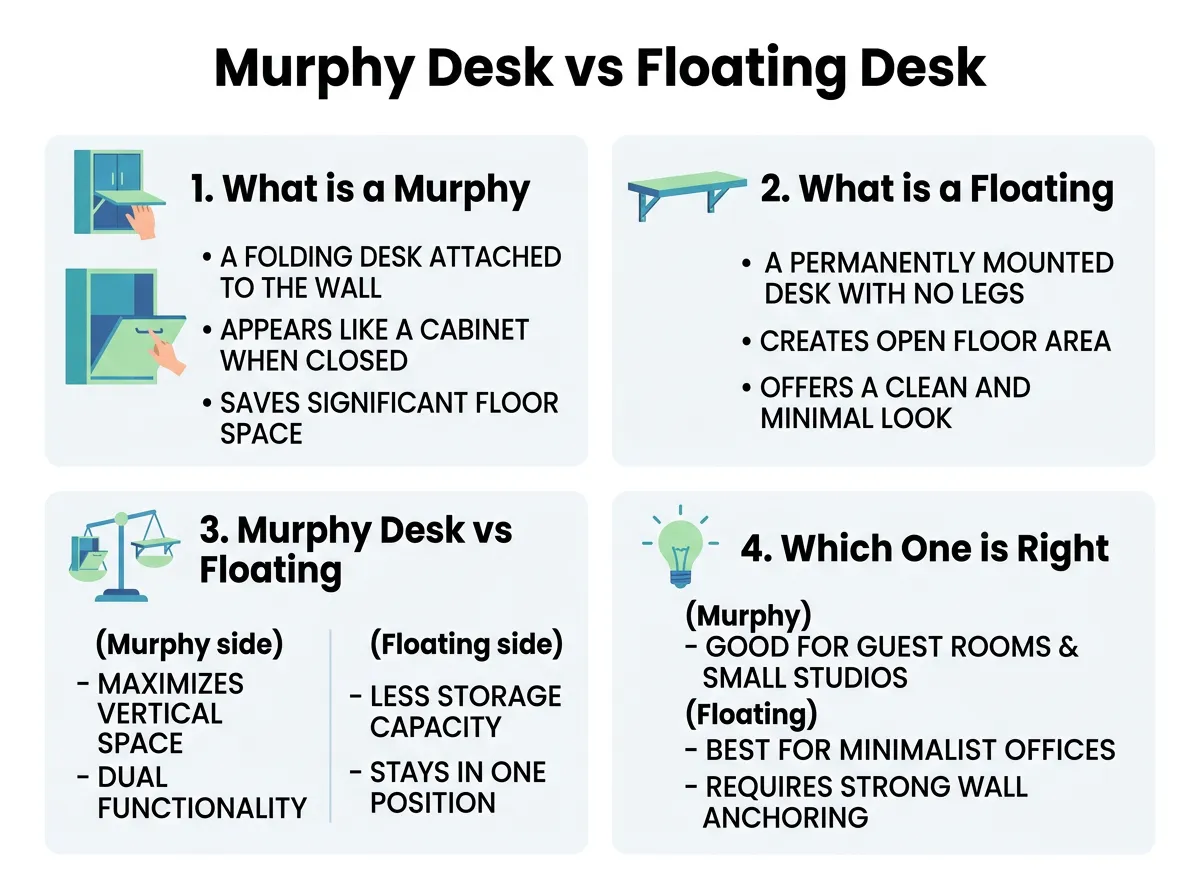
Murphy Desk vs. Floating Desk — key points at a glance
The Legless Profile
Because there are no legs, a floating desk creates a very clean look. You can easily slide your office chair underneath it. Cleaning is also a breeze. You can vacuum or sweep right under the desk without bumping into wooden legs. Some premium brands, such as Pith & Stem, design stunning wall-mounted workspaces that look like modern art while providing a sturdy place to work.
Pros of Floating Desks
- Always Ready: You do not need to fold or unfold anything. You can leave your laptop, mouse, and monitor in place.
- Sturdy Build: Because it is fixed in place, it can support more weight. It uses strong brackets screwed into wall studs.
- Modern Style: The minimalist, open look makes any room feel larger and more stylish.
Cons of Floating Desks
- Constant Footprint: The desk always juts out into the room. It does not save as much physical space as a folding desk.
- Visible Clutter: Any papers or cords on the desk will always be on display.
- Minimal Storage: Most floating desks are thin. They might have one or two small drawers, but they lack tall shelf space.
Murphy Desk vs. Floating Desk: Head-to-Head Comparison
To help you choose, let us compare these two desks across four key areas. This will show you how they perform in real-world use.
1. Space Saving and Flexibility
If your room is very tight, the Murphy desk wins this round. When closed, a Murphy desk only sticks out a few inches from the wall. This is ideal for a narrow hallway, a small guest bedroom, or a walk-in closet. A floating desk, however, always takes up the same amount of space. If you put a floating desk in a busy pathway, you will have to walk around it every single day.
2. Storage Capacity
Do you have a lot of office supplies? A Murphy desk offers smart, vertical storage. When you open the cabinet, you get access to small shelves and compartments. For example, a quality wall-mounted fold-down desk with shelves lets you store books, pens, and chargers right inside the unit. When you close the desk, everything stays safe inside. Floating desks rarely have this much storage. At most, they offer a shallow drawer or a small shelf underneath the main top.
3. Weight Capacity and Stability
If you use a heavy desktop computer, multiple screens, or heavy books, the floating desk is the better option. Floating desks are held up by solid steel brackets anchored to the wall studs. They do not rely on moving hinges. A Murphy desk relies on hinges and sometimes thin folding legs. If you lean too hard on a Murphy desk, you might strain the hardware. For heavy-duty setups, go with a floating desk.
4. Installation and Ease of Setup
Both desks require secure mounting. You must screw them into wooden wall studs. Do not try to hang either desk using only drywall anchors. If you do, the desk could fall and ruin your walls. However, Murphy desks are harder to install. They are heavy because of the cabinet back and door. You also have to make sure the unit is perfectly level so the hinges fold smoothly. Floating desks are usually lighter and simpler to align.
Which One is Right for You?
Still not sure? Let us break down the choice based on how you plan to use the space.
When to Choose a Murphy Desk
A Murphy desk is the perfect choice if:
- You work in a multi-use room, like a guest bedroom or a dining room, and you want to hide your work at the end of the day.
- You have a very narrow room where a permanent desk would block the walkway.
- You want to keep your room looking neat, tidy, and free of wires and paperwork.
- You only work on a light laptop or tablet and do not need a big monitor.
When to Choose a Floating Desk
A floating desk is the perfect choice if:
- You want a permanent workspace where you can leave your keyboard, monitor, and desk mat in place.
- You prefer a modern, minimalist look with clean lines and open floor space.
- You need a desk that can hold a heavy computer screen or several books without shaking.
- You have a dedicated corner of a room that does not need to serve other purposes.
Conclusion
In the debate of the Murphy desk vs. the floating desk, there is no single winner. It all comes down to how you use your space. If you need to reclaim every square inch of your room, the fold-away magic of the Murphy desk is hard to beat. It lets you work hard by day and tuck the office away by night.
On the other hand, if you want a sleek, permanent, and sturdy workspace that keeps your floor clear, the floating desk is an amazing choice. It gives you the modern look you want without the bulk of a heavy wooden frame. Assess your room, weigh your storage needs, and choose the desk that will help you do your best work.
Frequently Asked Questions
Are Murphy desks sturdy enough for daily use?
Yes, Murphy desks are sturdy enough for daily use with a laptop and basic office supplies. However, you should avoid leaning heavily on them or placing heavy desktop computers on the folding surface, as this can strain the hinges over time.
Can I install a floating desk on drywall without studs?
No, you should never install a floating desk on drywall alone. Desks hold a lot of weight, and the pressure of typing can pull drywall anchors right out of the wall. Always mount the brackets directly into wooden or metal wall studs.
How much weight can a floating desk hold?
A high-quality floating desk mounted properly into wall studs can typically hold between 50 and 100 pounds. The exact weight capacity depends on the bracket quality, the desk material, and how well it is secured to the studs.
Can you leave items on a Murphy desk when you fold it up?
You cannot leave tall items like monitors, coffee mugs, or desktop computers on the desk surface when folding it up. However, many Murphy desks have built-in interior shelves where you can store notebooks, pens, and thin laptops before closing the door.
Which option is better for a small bedroom?
A Murphy desk is usually better for a very small bedroom because it folds flat when you are done working. This gives you back physical room to walk around, stretch, or do other activities without a desk blocking your path.
Are floating desks cheaper than Murphy desks?
Generally, floating desks are cheaper than Murphy desks because they have a simpler design with fewer moving parts. Murphy desks require extra wood for the cabinet casing, as well as hinges, latches, and folding mechanisms, which increases the price.
