



Finding the correct desk height for a tall person is crucial to prevent slouching, neck strain, and joint pain. For individuals over six feet tall, standard 30-inch desks are simply too low, making a desk height of 31 to 33 inches for sitting and up to 48 to 52 inches for standing necessary. Using adjustable standing desks and ergonomic chairs will help you achieve a comfortable, pain-free posture.
Have you ever spent a long day at work only to stand up and feel like your back is locked in a tight knot? You stretch your arms, twist your torso, and hear a chorus of pops. If you are taller than average, this is likely a daily routine for you. The modern world is often built for people of average height. From airplane seats to kitchen counters, tall individuals must constantly bend, slouch, and squeeze into tight spaces. Unfortunately, your office setup is probably no different.
Most office furniture is made to fit a very specific, average demographic. When you do not fit into that average range, your body pays the price. You might find yourself hunching over your keyboard, craneing your neck to see your monitor, or cramming your long legs under a shallow tabletop. If you are struggling to stay comfortable, finding the right Desk Height for a Tall Person is the first step toward a pain-free workday. In this article, we will break down why standard desks fail tall users and how you can easily find your perfect ergonomic setup.
We will look at the science of office ergonomics, explore practical measurements for different heights, and highlight some simple tricks to lift your workspace. Let us get started on making your office a much more comfortable place to be.
Key Takeaways
- Standard Desks Are Too Low: Most standard desks are 30 inches tall, which is designed for people under 5 feet 10 inches.
- The 90-Degree Rule: Your elbows should rest at a comfortable 90-degree angle while typing, with your shoulders fully relaxed.
- Sitting Height Range: For tall individuals (6’0″ to 6’4″), the ideal sitting desk height is between 31 and 33 inches.
- Standing Desk Needs: Tall standing desk users need a desk that can extend up to 48 to 52 inches to maintain good posture.
- Do Not Forget Your Monitor: The top of your screen should sit at eye level so you do not have to tilt your head down.
- Simple Office Hacks: If you cannot buy a new desk, simple tools like bed risers or keyboard trays can help you raise your workspace.
📑 Table of Contents
The Problem with Standard Office Desks
Walk into any furniture store, and you will see row after row of beautiful desks. What you might not realize is that almost all of them share the exact same height. For decades, the industry standard for a writing or computer desk has been 30 inches. This number was not chosen at random, but it was chosen to fit the average male height of the mid-20th century, which was around 5 feet 9 inches.
Why 30 Inches Fails Tall Users
If you are 6 feet tall or taller, a 30-inch desk is simply too low. When you sit at a desk that is too short, several negative things happen to your posture. First, you are forced to hunch your shoulders forward to rest your arms on the surface. This rounds your upper back and puts immense pressure on your neck. Second, your knees may bump against the bottom of the desk or any drawers underneath. This forces you to slide your hips forward in your chair, leading to a slouched lower back. Over time, this poor alignment can lead to chronic pain, repetitive strain injuries, and tension headaches.
The Real Cost of Poor Ergonomics
Ignoring these ergonomic issues does more than just cause temporary discomfort. Working in a cramped space day after day can lead to long-term health problems. Your spine has a natural curve that acts as a shock absorber. Slouching flattens this curve, putting extra pressure on your spinal discs. This can lead to herniated discs, sciatica, and chronic muscle fatigue. By adjusting your work surface to the correct height, you protect your spine and boost your daily energy levels.
Calculating Your Perfect Desk Height
Calculating the perfect Desk Height for a Tall Person does not have to be a guessing game. You do not need to rely on trial and error. Instead, you can use simple body geometry to find the exact height that fits your frame. Using a reliable desk height calculator can help you find customized measurements based on your unique body proportions.
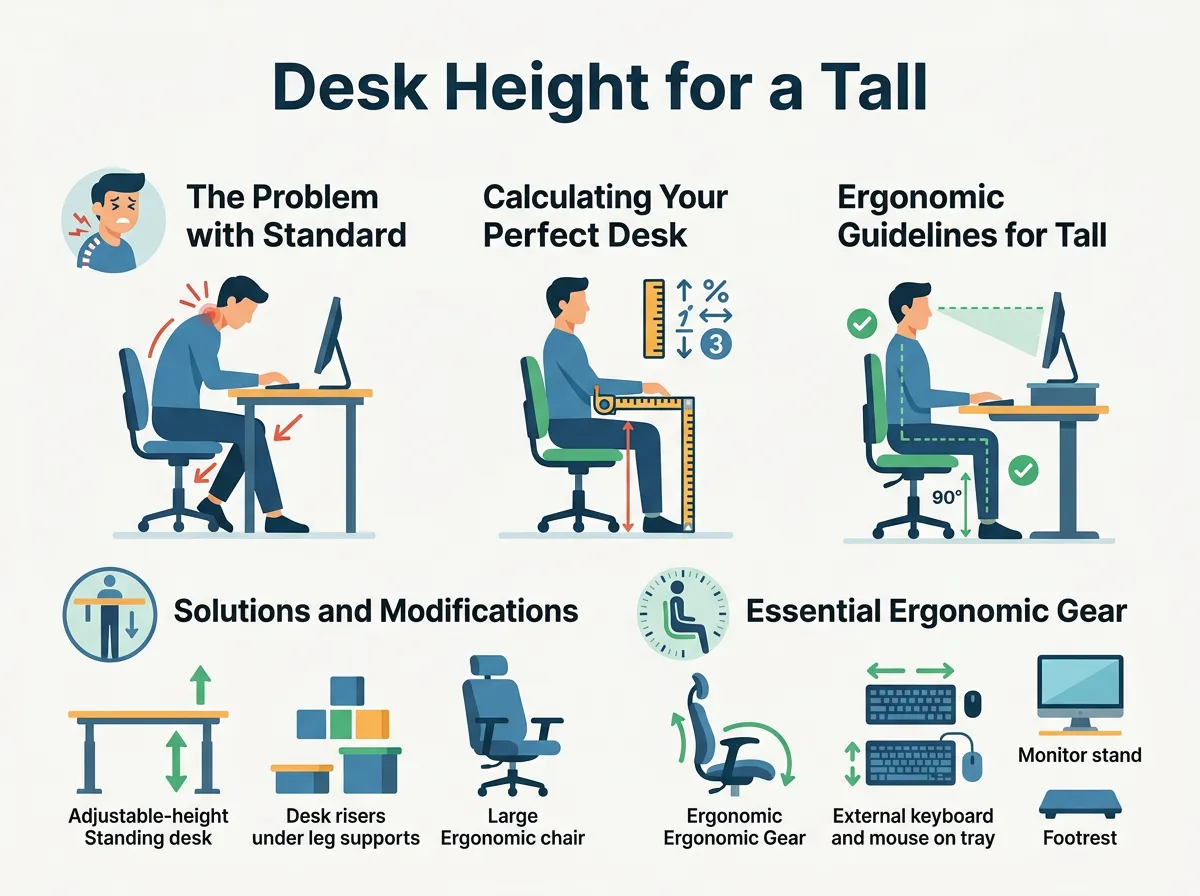
Desk Height for a Tall Person — key points at a glance
The Elbow Rule for Sitting
To find your ideal sitting desk height, sit comfortably in your office chair. Keep your feet flat on the floor and relax your shoulders. Bend your elbows at a 90-degree angle, keeping your upper arms close to your sides. The distance from the floor to the underside of your bent elbows is your ideal desk height. For a person who is 6 feet 2 inches tall, this number is usually around 31.5 to 32 inches. For someone who is 6 feet 5 inches tall, the ideal height may be closer to 33 or 34 inches.
Finding the Right Standing Desk Height
If you prefer to use a standing desk, the same basic geometric rule applies. Stand up straight with your feet shoulder-width apart. Keep your shoulders relaxed and bend your elbows at a 90-degree angle. Measure the distance from the floor to the bottom of your elbows. This is your target standing desk height. For tall users, finding a desk that goes high enough is a common challenge. You can find more details on choosing a standing desk for tall people to ensure you select a model with a high enough maximum extension range.
Ergonomic Guidelines for Tall Workers
Once you have your desk height sorted, there are a few other ergonomic factors to keep in mind. Your body works as a complete system, so a change in one area will affect another. Here are the key areas you should focus on to complete your ergonomic setup.
Eye Level and Monitor Placement
Even if your desk is at the perfect height, you will still experience neck pain if your computer screen is too low. Tall people often look down at their monitors, which places a heavy strain on the cervical spine. The top third of your computer screen should be right at your eye level. If you wear bifocals, you may need to lower the screen slightly. Use a monitor arm or a stack of sturdy books to lift your screen to the proper level.
Knee Clearance and Under-Desk Space
Tall legs need plenty of room to move. When you sit down, there should be at least several inches of space between the top of your thighs and the underside of the desk. You should also be able to stretch your legs forward without hitting the back wall of the desk or any support bars. Avoid desks with low-hanging drawers or built-in cabinets that block your legroom. Keeping the space under your desk clear allows you to shift positions naturally throughout the day.
Solutions and Modifications for Your Workspace
Now that you know what your body needs, how do you actually achieve it? You do not necessarily have to spend a fortune on custom-made furniture. There are several practical paths you can take to elevate your workspace, which outlines helpful rules for choosing desks for different heights depending on your daily physical needs.
Height-Adjustable Standing Desks
The single best solution for a tall person is a high-quality electric standing desk. These desks allow you to raise and lower the surface with the touch of a button. Look for a desk with a dual-motor system, as these tend to be more stable at their highest settings. Make sure the desk has a maximum height of at least 48 to 50 inches if you are over six feet tall. If you are taller than 6 feet 4 inches, you may need a desk that extends up to 52 inches.
Simple DIY Hacks for Existing Desks
If buying a new desk is not in your budget right now, do not worry. You can easily modify your current desk with a few affordable accessories.
- Furniture Risers: You can place heavy-duty plastic or wooden bed risers under the legs of your desk to lift it by 2 to 3 inches.
- Desk Leg Extenders: If your desk has metal pipe legs, you can find screw-on extenders online that will add extra height.
- Keyboard Trays: An adjustable under-desk keyboard tray can be lowered or tilted to help you achieve that perfect 90-degree elbow angle without changing the desk itself.
Essential Ergonomic Gear for Tall Individuals
To get the most out of your newly adjusted desk, you will want to pair it with the right supporting gear. These tools help maintain your alignment and keep you comfortable during long working hours.
Ergonomic Chairs with Tall Gas Cylinders
Your chair is just as important as your desk. Standard office chairs often do not rise high enough to allow a tall person’s thighs to rest parallel to the floor. Look for a chair that offers a “tall” gas cylinder option, which increases the maximum seat height. Additionally, ensure the chair has a deep seat pan so your thighs are fully supported without pressing against the back of your knees.
Adjustable Monitor Arms
An adjustable monitor arm is a game-changer for tall office workers. Instead of propping your screen up on a static stand, a monitor arm allows you to pull the screen closer, push it away, or raise it high above the desk surface. This flexibility is excellent for preventing eye strain and keeping your neck in a neutral, relaxed position.
A Final Word on Workspace Comfort
Finding the right Desk Height for a Tall Person is not about luxury; it is about taking care of your health. Your body is not designed to slouch over a tiny, cramped workspace for eight hours a day. By making a few simple adjustments, you can eliminate distracting aches and pains, boost your productivity, and finish your workday feeling energized instead of exhausted. Take a few minutes today to measure your elbow height and look at your current desk setup. Your back, neck, and shoulders will thank you for years to come.
Frequently Asked Questions
What is the absolute best desk height for a person who is 6 feet 2 inches tall?
For someone who is 6 feet 2 inches tall, the ideal sitting desk height is around 31.5 to 32 inches. When standing, the desk should be adjusted to approximately 48 inches. Always use your elbow comfort as the final guide.
Can I use standard furniture risers to lift my office desk?
Yes, heavy-duty furniture risers are a simple and highly budget-friendly way to raise your current desk. Just make sure the risers are rated to support the weight of your desk, computer gear, and arms. Also, ensure the desk remains stable and does not wobble after being raised.
Why do my shoulders hurt even when my desk is set to the correct height?
Shoulder pain often happens when your computer monitor is too low, causing you to lean forward and hunch your shoulders. It can also occur if your armrests are set too high, pushing your shoulders up toward your ears. Try raising your screen to eye level and relaxing your arms naturally.
How do I know if my office chair is too low for my height?
If your knees are positioned higher than your hips when sitting, your chair is definitely too low. This angle places extra pressure on your lower back and hip joints. Ideally, your thighs should be parallel to the ground with your feet resting flat on the floor.
Are standing desk converters good for tall individuals?
Standing desk converters can work well, but you must check their maximum height extension before buying. Many cheaper models do not rise high enough for tall users, which can force you to look down at your screen. Look for converters specifically rated for taller heights.
How does a keyboard tray help with a desk that is too high?
An adjustable under-desk keyboard tray allows you to lower your typing surface below the main desktop level. This is an excellent way to achieve a perfect 90-degree elbow angle without having to replace your entire desk. It also frees up valuable workspace on your desktop.
