



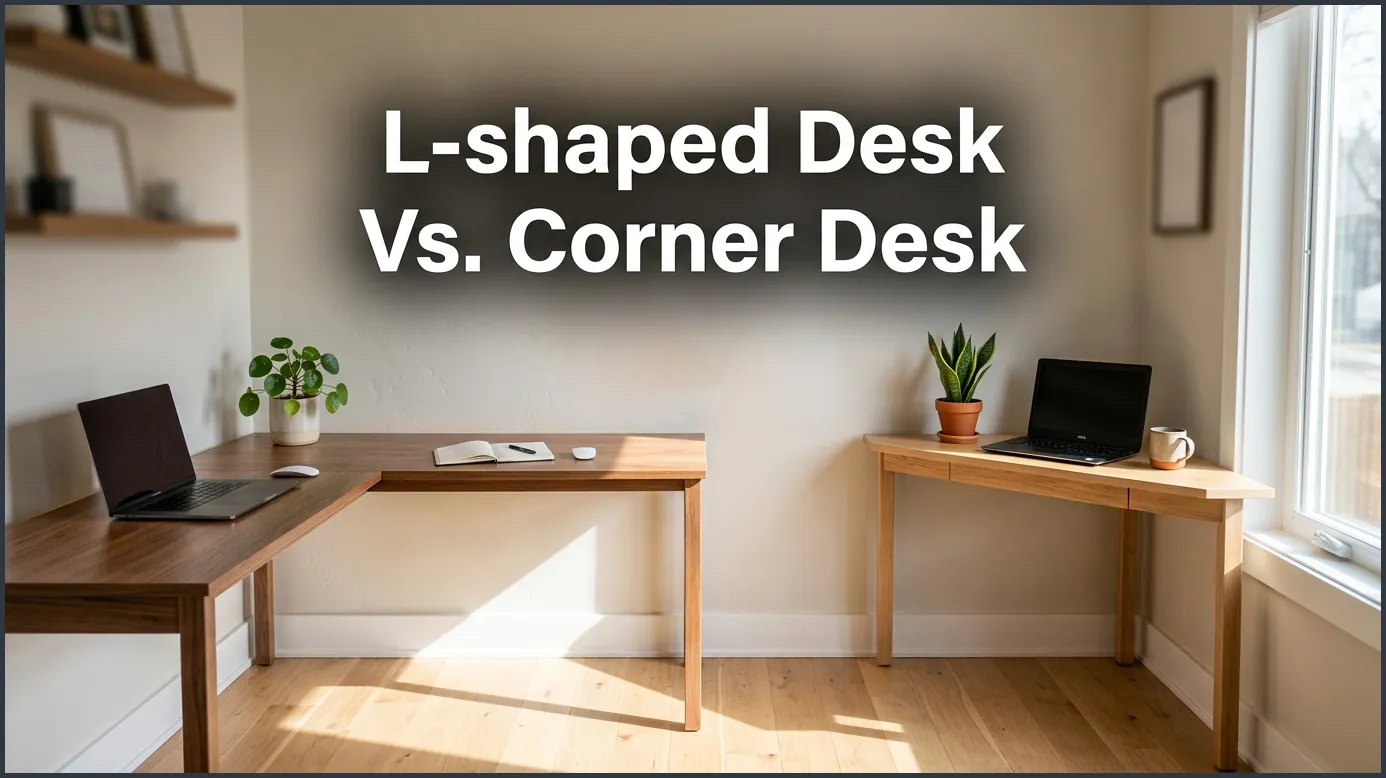
When comparing an L-shaped desk vs. a corner desk, the best choice depends on your room size and work needs. L-shaped desks offer two long, connected work surfaces that are perfect for multitasking and multi-monitor setups. Corner desks feature a compact, triangular design made specifically to fit snugly into tight corners, making them the ultimate space savers for small rooms.
Imagine walking into your home office at the start of a busy day. You have a warm cup of coffee in your hand, a long to-do list, and a brand new computer. But as you look around, you realize your current work setup is not helping you. Your papers are piled high, your keyboard is crowded, and you feel cramped. You need a new desk, but you are not sure which style to choose. The space in your room is limited, and you want to make the most of every square inch.
This brings us to a classic office design dilemma. How do you choose between an L-Shaped Desk vs. Corner Desk? Both options are designed to fit into corners and save space. They both look great and offer unique benefits. However, they serve very different needs and fit different lifestyles. Choosing the wrong one can lead to a cluttered workspace and a sore back.
In this guide, we will break down the key differences between these two popular desk styles. We will look at how they use space, how much they hold, and how comfortable they are to use. By the end of this article, you will know exactly which desk is the perfect match for your home or office.
Key Takeaways
- Space Efficiency: Corner desks are perfect for tiny rooms because they tuck neatly into 90-degree corners and keep the room open.
- Surface Area: L-shaped desks offer much more desktop space, which is great for multiple monitors and heavy multitasking.
- Placement Versatility: L-shaped desks can sit in a corner or float in the center of a room, while corner desks must stay against the walls.
- Ergonomics: Sitting at an L-shaped desk lets you easily rotate between tasks, but you must plan your monitor placement carefully.
- Storage Options: L-shaped desks usually come with more built-in shelving, drawers, and cabinet options than compact corner desks.
- Budget Friendly: Corner desks generally cost less due to their smaller size, while L-shaped desks are a larger financial investment.
📑 Table of Contents
Understanding the Basics: What Is the Difference?
Before we dive into the details, we need to clarify what these desks actually are. Many people use these terms interchangeably. They assume that any desk that fits in a corner is a corner desk. But in the furniture world, there is a clear distinction between an L-Shaped Desk vs. Corner Desk. Let us look at what makes each style unique.
Defining the L-Shaped Desk
An L-shaped desk looks exactly like the letter “L.” It consists of two rectangular work surfaces that meet at a 90-degree angle. One side of the desk is usually longer than the other side. This longer side is often called the main desk, while the shorter side is called the return. You can read about desk return orientation to see how this affects your room layout. This shape gives you two distinct work zones. You can use one side for your computer and the other side for writing, reading, or sorting physical files.
Defining the Corner Desk
A corner desk is shaped like a triangle. The back of the desk is designed to fit flat against two walls in a corner. The front of the desk, where you sit, is usually curved or flat and faces out into the room. This design is highly compact. It is built specifically to occupy the deep corner space that usually goes to waste. If you want to compare other styles, you can read about the pros and cons of corner desks to see how they match up against standard straight desks.
Space and Layout: Where Will Your Desk Fit?
The size of your room is the most important factor when choosing a desk. You must measure your floor space before you buy anything. Let us look at how each desk option behaves in a room.
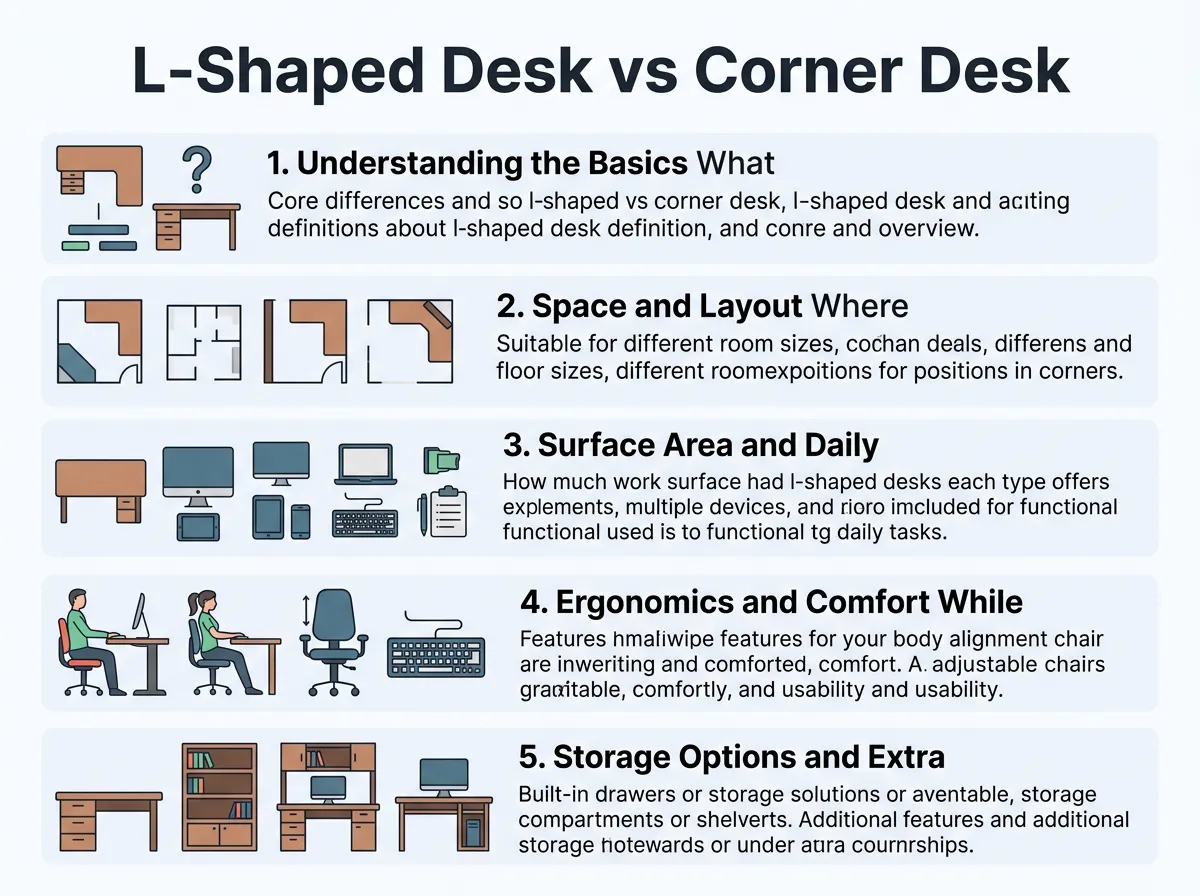
L-Shaped Desk vs. Corner Desk — key points at a glance
Room Placement Options
An L-shaped desk is surprisingly versatile. Many people think it has to go in a corner, but that is not true. You can place an L-shaped desk in the middle of a room. This is called floating the desk. Floating your desk can help divide a large room into separate zones. For example, you can separate your sleeping area from your work area in a studio apartment. A corner desk, on the other hand, is not versatile. It must go in a corner. If you place a corner desk in the middle of a room, the triangular back will look very strange and waste a lot of space.
Perfect for Small Rooms
If you are working in a tiny bedroom or a small hallway, floor space is at a premium. In this scenario, the corner desk is the clear winner. It has a very small footprint. It tucks away into the corner and leaves the rest of the room completely open. An L-shaped desk is much larger. Even a small L-shaped desk takes up a significant amount of wall space on two sides. If your room is already crowded, an L-shaped desk might make the space feel cramped and hard to walk through.
Surface Area and Daily Productivity
How do you work during the day? Do you use a single laptop, or do you have a complex setup with multiple screens and devices? The amount of surface area you need will help you decide between an L-Shaped Desk vs. Corner Desk.
Multitasking and Dual Monitors
If you need to use two or three monitors, you need an L-shaped desk. The long, flat surfaces give you plenty of room to spread out. You can set up your computer screens on one side and still have the entire other side free for other tasks. This is perfect for gamers, programmers, and students. You can have your computer running on one side while you take notes or study a textbook on the other side.
Desktop Reach and Organization
A corner desk offers a different kind of convenience. Because of its triangular shape, you sit right in the center of the desk. This means that almost the entire surface is within arm’s reach. You do not have to stretch or slide your chair to grab a pen, a notepad, or your coffee cup. However, the total surface area is limited. If you try to put a large monitor, a printer, and a keyboard on a corner desk, you will quickly run out of room. It is best for simple setups with just a laptop or a single small monitor.
Ergonomics and Comfort While Working
Working at a desk for several hours a day can take a toll on your body. Good ergonomics are essential to prevent back pain, neck strain, and wrist fatigue. Let us look at how these desks compare when it comes to physical comfort.
Finding Your Perfect Seating Position
When you use an L-shaped desk, you must decide where you sit at your desk. Some people prefer to sit right in the inner corner of the L-shape. This can feel cozy, but it can also restrict your movement. Others prefer to sit on one of the straight sides of the desk. Sitting on a straight side is often better for your wrists and neck. It allows you to face your computer screen directly and keep your keyboard at a comfortable angle.
Preventing Strain and Fatigue
With a corner desk, you have no choice but to sit in the very corner. This can be very comfortable because the desk wraps around your arms and provides good support. However, you must be careful about your monitor distance. Because corner desks are deep in the back, your monitor might end up too far away. This can cause you to squint or lean forward, which puts strain on your neck. You must make sure your chair is at the correct height and that your screen is positioned perfectly to avoid fatigue.
Storage Options and Extra Features
A desk is not just a flat board to hold your computer. It is also a storage hub for your office supplies, files, and personal items. Let us look at how these desks handle storage.
Under-Desk Space and Drawers
L-shaped desks are larger, which means they have more room for built-in storage. You can easily find models that include drawers, filing cabinets, and shelves. Even with these storage units, you will still have plenty of legroom underneath. You can stretch your legs out without hitting a cabinet or a desk leg.
Shelving and Cable Management
Corner desks often use vertical space to make up for their small footprints. Many models come with a hutch, which is a set of shelves that sits on top of the desk. This is a great place to store books, plants, and office supplies. However, cable management can be a challenge. Because a corner desk fits tightly against two walls, it can be hard to route cords and cables. You should look for a corner desk with built-in cable holes to keep your wires organized and out of sight.
Making Your Final Choice: Which Is Best for You?
Now that you know the differences, it is time to make your choice. Let us look at a few simple questions to guide your purchase decision.
Choose an L-shaped desk if:
- You have a medium to large room with open wall space.
- You use multiple monitors or have a lot of office equipment.
- You need separate zones for typing and physical paperwork.
- You want built-in storage like drawers and filing cabinets.
Choose a corner desk if:
- You are working in a small room, bedroom corner, or apartment.
- You use a single laptop or a compact computer setup.
- You want to keep your floor space as open as possible.
- You are on a tight budget and want an affordable option.
Both of these desks are excellent tools for creating a productive workspace. Think about your daily work habits, measure your room carefully, and choose the desk that fits your lifestyle. With the right choice, you will create a comfortable, organized, and inspiring place to work every day.
Frequently Asked Questions
What is the main difference between an L-shaped desk and a corner desk?
An L-shaped desk consists of two long, rectangular work surfaces that meet at a 90-degree angle, offering a large and versatile workspace. A corner desk is shaped like a triangle and is designed specifically to fit snugly into a room’s corner to save floor space. L-shaped desks are much larger, while corner desks are compact and ideal for small rooms.
Can you use multiple monitors on a corner desk?
While you can use multiple monitors on a corner desk, it is often very difficult due to the limited desktop surface area. You may only have room for two small screens, and they might feel crowded or too close to your eyes. If you need a multi-monitor setup, an L-shaped desk is a much better choice because of its long, flat surfaces.
Do L-shaped desks have to go in the corner of a room?
No, L-shaped desks do not have to go in a corner. They are highly versatile and can be placed in the middle of a room, which is often called floating. This layout can help divide a larger room into separate functional zones, such as separating a workspace from a living area.
Are corner desks cheaper than L-shaped desks?
Generally, yes, corner desks are less expensive than L-shaped desks. Because corner desks are smaller and use fewer materials, they are highly budget-friendly. L-shaped desks are larger, heavier, and often come with more built-in storage, which makes them a more expensive investment.
Which desk style is better for ergonomics?
Both styles can be ergonomic if they are set up correctly, but L-shaped desks offer slightly more flexibility. An L-shaped desk allows you to sit on a straight side, which makes it easier to position your monitor and keyboard at the correct distance. Corner desks force you to sit in the corner, which can sometimes place your monitor too far away and lead to neck strain.
Is it hard to assemble an L-shaped desk compared to a corner desk?
Yes, L-shaped desks are typically harder and take longer to assemble because they are larger and have more parts. They often include drawers, shelves, and heavy metal frames that require careful installation. Corner desks are smaller and simpler, making them much quicker and easier to put together by yourself.
