



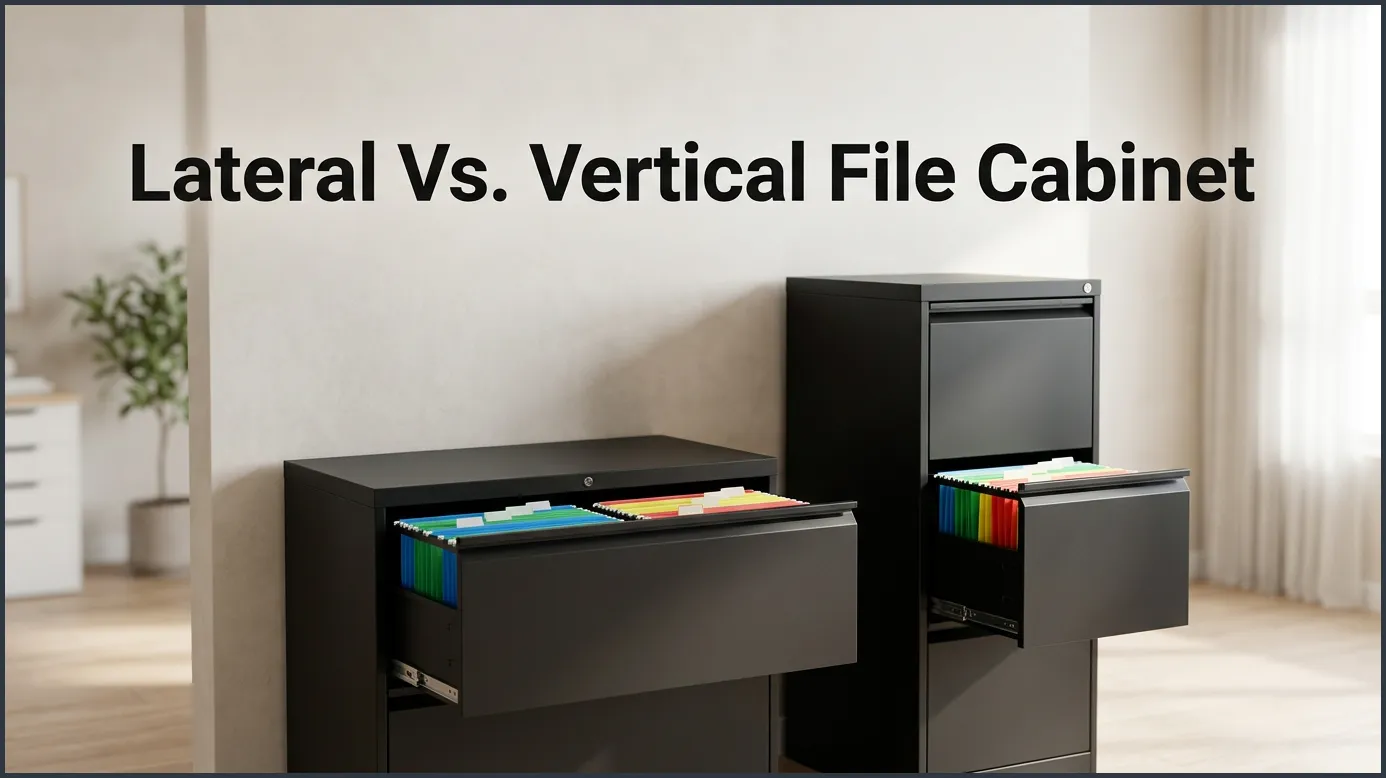
Choosing between a lateral and vertical file cabinet depends entirely on your available office floor space and document volume. Vertical cabinets are deep and narrow, making them ideal for tight corners with low filing needs, while lateral cabinets are wide and shallow, offering high-capacity storage for busy offices. Understanding these key physical differences will help you create a highly efficient, organized, and productive workspace.
Imagine walking into your workspace on a busy Monday morning. You have a warm cup of coffee in one hand and a stack of important client files in the other. You look around, but your desk is already buried under a mountain of paper. You know it is time to get organized. You need a reliable place to store your records, but the options seem endless. The big decision usually comes down to one classic debate: which design will serve you best?
Choosing the right office furniture is more than just a quick shopping trip. It affects how fast you find your work, how much room you have to move, and how neat your room looks. The choice you make today will shape your daily work habits for years to come. A poor choice can block your paths or leave you with jammed drawers that refuse to shut.
In this guide, we will look at the details of both storage designs. We will cover how they use space, how many documents they hold, and how safe they are to use. By the end, you will know exactly which style fits your unique workflow and room layout.
Key Takeaways
- Floor Space: Vertical cabinets extend far into the room, while lateral cabinets sit flush against the wall to save walking path space.
- Storage Volume: Lateral units hold more files per drawer and let you organize papers side-by-side or front-to-back.
- Document Types: Vertical systems mostly hold letter and legal files, while lateral systems handle diverse sizes with ease.
- Safety Concerns: Lateral cabinets are safer and less likely to tip over due to their wide base and anti-tip drawer locks.
- Dual Purpose: The wide top of a lateral cabinet can double as a printer stand, counter, or decorative shelf.
📑 Table of Contents
What is a Vertical File Cabinet?
The vertical model is the traditional unit that most people picture when they think of an office. It has been a staple of workspaces for over a century. In fact, the history of the filing cabinet shows that these tall, deep units helped shape modern businesses. They are built to stand tall and narrow, making them a familiar sight in quiet corners and small cubicles.
Key Features of Vertical Cabinets
These units are famous for their depth. They usually measure anywhere from 25 to 28 inches deep. They are quite narrow, often measuring just 15 inches wide. This means they do not take up much wall space. The drawers pull out very far into the room. This long drawer pull allows you to view your files from front to back. You stand directly in front of the drawer and look down the line of folders.
Best Use Cases for Vertical Cabinets
These units work best when you have limited wall space but plenty of clear floor space in front of the unit. They fit perfectly in tight corners, next to desks, or tucked into small alcoves. If you only need to store standard letter or legal-size papers, a vertical unit is a great match. It is also an excellent option for personal offices where only one person needs to access the files at a time.
What is a Lateral File Cabinet?
The lateral model offers a modern twist on office organization. Instead of going deep, it goes wide. It sits flat against your wall like a dresser or a credenza. This design is highly popular in modern corporate settings and busy home offices because of its clean, low-profile look.
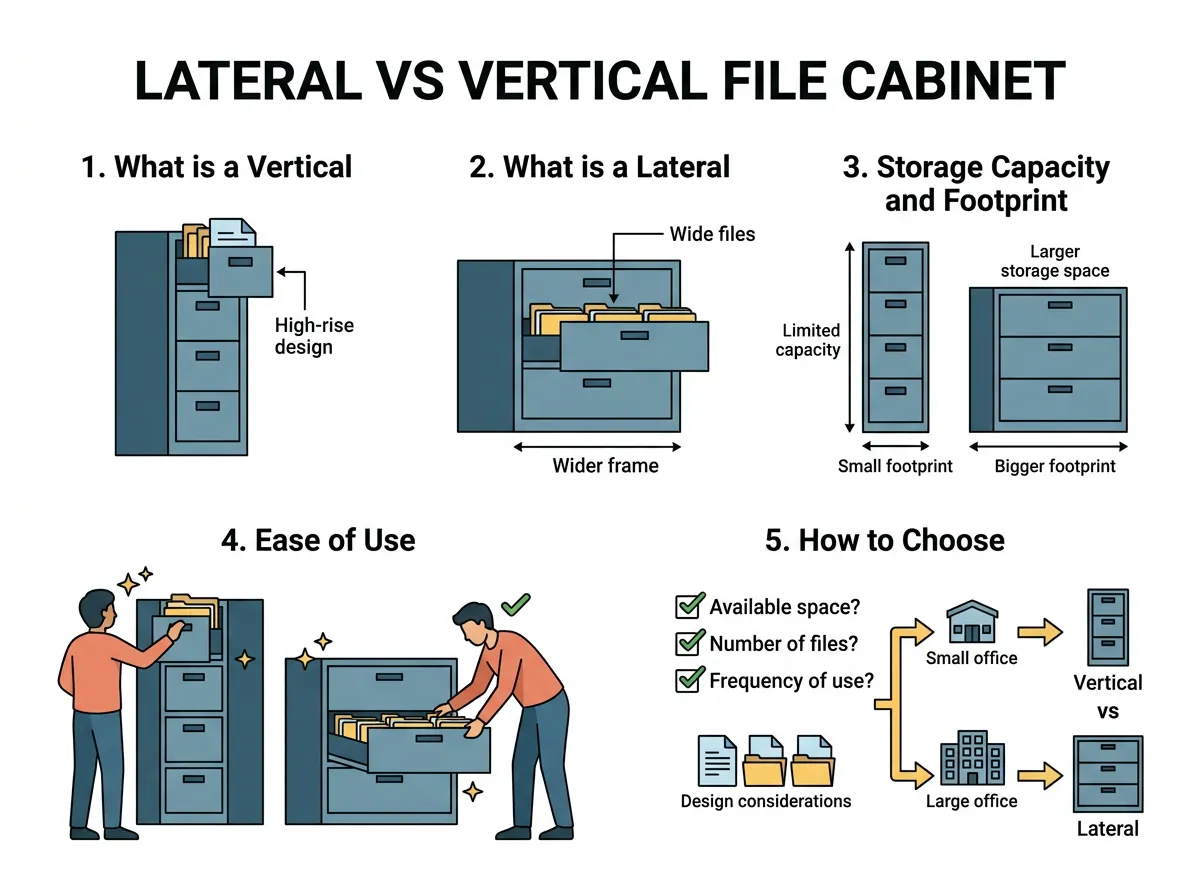
Lateral vs. Vertical File Cabinet — key points at a glance
Key Features of Lateral Cabinets
These units are wide and shallow. They usually measure between 30 and 44 inches wide, but they are only about 18 to 20 inches deep. When you pull out a drawer, it does not extend very far into your walking path. Inside the drawer, you can arrange your files in two different ways. You can line them up from left to right, or you can use rails to arrange them front to back in multiple rows.
Best Use Cases for Lateral Cabinets
These units are ideal for high-traffic walkways where a long drawer would block people from walking past. They are also perfect for open-plan offices with plenty of wall space. Because they are wide and stable, they work well as room dividers. You can use them to separate two desk areas. The flat, wide top also acts as an extra table. You can use it to hold a heavy printer, store office supplies, or display a few green plants.
Storage Capacity and Footprint: The Space Dilemma
When you compare a Lateral vs. Vertical File Cabinet, space is your most important metric. You must think about both the physical size of the box and how much paper it can hold. It is a balancing act between the room you have and the files you own.
Comparing Floor Space
A vertical unit has a small footprint on the floor, but it needs a lot of empty space in front of it. You must be able to pull the drawer out all the way without hitting your chair or a wall. If your room is narrow, a vertical drawer can completely block the path when it is open. On the other hand, a lateral unit takes up more wall space. However, because the drawers are shallow, they only pull out a short distance. This makes lateral units a smart choice for narrow hallways or tight rooms where people need to walk by while you file.
Drawer Capacity and Document Types
When it comes to sheer volume, the lateral design is the clear winner. If you want to know which holds more, lateral units win because they let you store papers side-by-side. A single wide drawer can hold more files than two narrow vertical drawers. Lateral units are also highly versatile. They can hold letter, legal, A4, and even large ledger-size documents. Vertical drawers are locked into one size, which is usually just standard letter or legal folders.
Ease of Use and Accessibility
How you interact with your files every day matters. A good filing system should not feel like a chore to use. It should make finding your documents quick and painless.
Filing Orientation
In a vertical unit, you stand at the front and flip through folders that go back into the deep drawer. If the drawer is full, it can be hard to read the labels at the very back. In a lateral unit, you stand facing the wide side. You can scan all the file tabs from left to right in a single glance. Many people find this layout much easier on the eyes. It speeds up the time it takes to find a specific client record.
Safety and Anti-Tip Features
Safety is a major factor when dealing with heavy paper storage. Paper is surprisingly heavy. A single drawer full of files can weigh over a hundred pounds. Because vertical units are tall and narrow, they have a higher center of gravity. If you pull out two heavy top drawers at the same time, the whole unit can tip forward. Lateral units have a wider base, which makes them naturally more stable. Most high-quality lateral models also feature an anti-tip safety lock. This system ensures that only one drawer can open at a time, which prevents dangerous office accidents.
How to Choose the Best Option for Your Workspace
To make the right choice, you need to assess your office layout and your daily habits. Take a moment to think about how you work. Here are three simple steps to help you decide between a Lateral vs. Vertical File Cabinet for your space.
- Step 1: Measure Your Room. Use a tape measure to check your floor space. Mark where the cabinet will go. Measure the space with the drawers fully open to make sure you still have room to stand and walk.
- Step 2: Check Your File Sizes. Look at the documents you need to store. Are they all standard letter size? Or do you have large folders, legal documents, and binders? If you have mixed sizes, a lateral cabinet is your best bet.
- Step 3: Look at the Traffic Flow. Is the cabinet going in a busy hallway? If yes, buy a lateral unit. Is it going in a quiet corner behind your desk? A vertical unit will work beautifully there.
For more details on how these two styles match up in real office setups, you can read this helpful comparison of vertical vs lateral filing options. It offers great layout tips to keep your workspace safe and efficient.
Summary Comparison of Features
Let us look at a quick wrap-up of how these two styles compare across key categories:
- Width: Vertical is narrow (15 inches); Lateral is wide (30 to 44 inches).
- Depth: Vertical is deep (25 to 28 inches); Lateral is shallow (18 to 20 inches).
- Capacity: Vertical is low to medium; Lateral is high.
- Versatility: Vertical holds one size; Lateral holds multiple sizes.
- Top Surface: Vertical is too small to use; Lateral is wide enough for printers or decor.
Conclusion
There is no single winner in the battle of the Lateral vs. Vertical File Cabinet. The best choice is the one that fits your physical room and your filing habits. If you are short on wall space and only store standard letters, a vertical unit will serve you well. It is a classic, budget-friendly option. But if you have a wide wall, need to store diverse files, or want a stable surface for your printer, a lateral unit is worth the investment. Take your measurements, check your file sizes, and choose the cabinet that makes your workday feel smooth and organized.
Frequently Asked Questions
Which cabinet holds more files?
Lateral file cabinets hold more files because they are much wider. They allow you to store files side-by-side and can accommodate multiple rows of documents in a single drawer.
Can I store legal-sized files in a vertical cabinet?
Yes, you can, but you must buy a vertical cabinet specifically designed for legal-sized documents. Vertical units are usually built to hold either letter or legal sizes, but not both in the same drawer.
Are lateral file cabinets safer than vertical ones?
Yes, lateral cabinets are generally safer because they have a wider base and a lower center of gravity. Most models also come with anti-tip mechanisms that prevent more than one drawer from opening at once.
Can I use the top of a lateral file cabinet as a desk?
While it may be too tall to use as a main desk, the top of a lateral cabinet is perfect as an extra work surface. It is ideal for holding printers, scanners, or trays of active paperwork.
Which option is better for a small home office?
A vertical cabinet is usually better for a small home office if you have an unused corner. However, if your home office is in a narrow hallway, a lateral cabinet is better because its drawers do not pull out as far.
Do lateral cabinets cost more than vertical cabinets?
Yes, lateral file cabinets usually cost more than vertical ones. They require more materials to build, feature complex safety systems, and offer larger storage capacities.
