




Lumbar support in a chair is a physical feature designed to support the lower region of your spine, keeping your posture aligned and reducing strain. By filling the gap between your lower back and the seat back, it promotes the spine’s natural curve and prevents slouching. Incorporating this feature into your daily seating can significantly lower your risk of chronic back pain and fatigue.
Picture this: you are halfway through a long workday. Your neck feels tight, your shoulders are tense, and your lower back has a dull, nagging ache. You try to sit up straight, but within five minutes, you slouch right back down into your seat. We have all been there. Sitting for long hours is a regular part of modern life, but our bodies were not built to stay still for so long.
If you have ever shopped for a new desk setup, you have likely seen the term “lumbar support” everywhere. It is often praised as the ultimate cure for desk fatigue. But what does this actually mean for your body, and why does it matter so much? In this guide, we will explore the science of spinal health, look at the different types of support systems, and help you find the perfect setup for your daily routine.
Key Takeaways
- Supports the Spine: It keeps the natural inward curve of your lower back intact while sitting.
- Reduces Back Pain: By relieving pressure on your spinal discs, it prevents dull aches and muscle strain.
- Improves Posture: It naturally aligns your shoulders, neck, and head, making it easier to sit upright.
- Highly Adjustable: The best chairs let you move the support up, down, forward, or backward to fit your body.
- Boosts Energy Levels: Good posture opens up your chest, which improves breathing and blood flow throughout the day.
- Budget-Friendly Options Exist: You do not need a brand-new chair; you can easily add external cushions to your current seat.
📑 Table of Contents
The Anatomy of Your Lower Back
To understand why chairs need special shapes, we must first look at our own bodies. Your spine is not a straight line. It has natural curves that look like a soft, graceful “S” shape. This shape helps your body absorb shock and carry your weight when you walk, run, and jump.
Understanding the Lumbar Curve
The bottom part of this “S” is your lumbar spine. It consists of five bones in your lower back. This area naturally curves inward, toward your belly. When you stand up, this curve stays in its natural position. Your weight is spread out evenly. Your muscles do not have to work too hard to keep you upright.
What Happens When We Slouch?
Everything changes when we sit down. Most standard chairs do not help us keep that inward curve. Instead, we roll our hips backward. The lower back flattens out or even curves outward. This posture puts a huge amount of pressure on your spinal discs. It stretches the muscles and ligaments in your back. Over time, this causes strain, muscle fatigue, and pain. You can read more about understanding the basics of seat ergonomics to see how this affects your body over time.
What Is Lumbar Support in a Chair?
When people ask, “What Is Lumbar Support in a Chair?” they are looking at the core solution to sitting pain. Simply put, it is any design feature or cushion that fills the gap between the chair and your lower back. It is there to protect your posture.
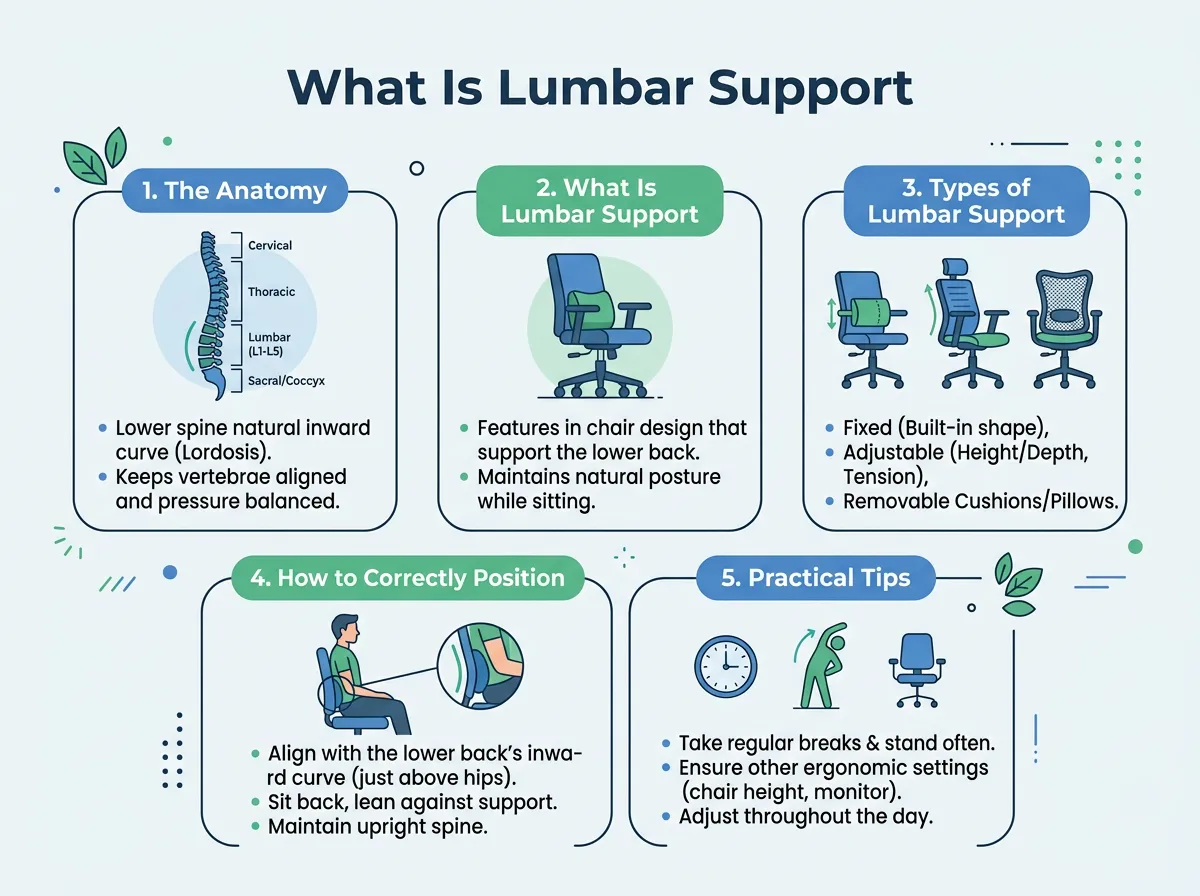
What Is Lumbar Support in a Chair? — key points at a glance
The Main Job of the Support
The main job of this support is to keep your lower spine in its natural, inward curve. It acts like a gentle hand holding your lower back in place. When your lower back is supported, your whole upper body aligns. Your shoulders relax, your neck sits naturally, and your head does not lean forward toward your computer screen.
Why Just Slouching Less Does Not Work
Many people try to use sheer willpower to sit up straight. This rarely works. Your muscles get tired after just a few minutes. You get distracted by your work, your phone, or a call. Before you know it, you are slouching again. A good support system does the hard work for you. It holds your shape even when you forget about your posture.
Types of Lumbar Support Systems
Not all chairs are made the same way. There are a few common types of support systems you will find when shopping for office furniture.
Fixed Lumbar Support
This is the simplest type. The chair has a built-in curve in the plastic or mesh backrest. It does not move or change shape. It works well if the chair fits your body size perfectly. However, if you are very tall or very short, a fixed curve might sit in the wrong spot on your back.
Adjustable Lumbar Support
This is a highly popular option. It lets you change how the support fits your body. You can often slide the support pad up or down. Some chairs also let you change the depth. This means you can control how hard or soft the push against your back feels. This is great if multiple people share the same chair.
Dynamic and Self-Adjusting Support
These are found on high-end office chairs. They use smart designs that change shape automatically as you move. When you lean back or twist, the support shifts with you. This keeps your spine in line no matter how you sit.
External Lumbar Pillows
If your current chair does not have built-in support, you do not need to buy a brand-new chair. You can use an external cushion. Many people find success by adding an external lumbar support cushion to their current seat. These are budget-friendly, highly portable, and easy to move from your office chair to your car.
How to Correctly Position Your Lumbar Support
Buying a chair with support is only the first step. You also have to set it up the right way. If the support is in the wrong place, it can actually cause more pain.
Finding the Right Spot
The support should fit right in the small of your back. This is the narrow part of your spine just above your belt line. It should feel like a gentle, comfortable push. It should not pinch, feel hard, or cause you to arch your back too much.
Step-by-Step Setup Guide
First, sit all the way back in your chair. Your bottom should touch the very back of the seat. Next, slide the support up or down until it rests in your lower back curve. If you want to refine this, check out this guide on how to position lumbar support correctly. Adjust the depth until you feel supported but not pushed forward out of your seat. Your feet should rest flat on the floor, and your knees should be bent at a ninety-degree angle.
Practical Tips for a Healthier Back
Even the best chair in the world cannot solve everything. Our bodies are made to move, and sitting still for hours is never ideal.
Take Regular Breaks
Try to stand up every thirty minutes. Walk around for a minute, stretch your arms, or grab a glass of water. This lets fresh blood flow to your muscles and spine, keeping you alert and healthy.
Strengthen Your Core
Your core muscles act like a natural corset for your spine. Strong abs and back muscles help you stay upright with less effort. Simple exercises like planks can make a huge difference in how you sit.
Listen to Your Body
If you feel a dull ache, do not ignore it. Change your position, stretch, or adjust your chair. Your body uses pain to tell you that something needs to change. Keep adjusting until you find a setups that keeps you comfortable.
Conclusion
Your back is the foundation of your daily comfort and long-term health. Understanding how lumbar support works is a vital step toward a pain-free life. By choosing a chair that supports your spine’s natural curve, you can say goodbye to end-of-day aches. Take the time to adjust your chair, listen to your body, and keep moving throughout the day. Your spine will thank you for years to come!
Frequently Asked Questions
Where should lumbar support be placed?
It should rest in the small of your back, just above your belt line. This is the natural inward curve of your lower spine. Placing it here keeps your entire back aligned.
Can lumbar support cause back pain?
Yes, if it is placed incorrectly or is too thick, it can cause discomfort. Make sure it fits the natural curve of your spine without pushing you forward.
Is a rolled towel a good substitute for lumbar support?
Yes, a rolled-up towel can work as a quick, temporary fix. Place it behind your lower back to maintain your spine’s natural curve while sitting.
How do I know if my chair has enough lumbar support?
You should feel a gentle, comfortable pressure against your lower back when sitting all the way back. If you still find yourself slouching or feeling sore, you may need more support.
Does everyone need lumbar support?
Yes, anyone who sits for long periods can benefit from it. It prevents muscle fatigue and protects your spinal discs from extra pressure.
Can I add lumbar support to any chair?
Absolutely, you can buy external cushions or pillows designed for this purpose. They easily attach to office chairs, car seats, or dining chairs with adjustable straps.
