



To measure for a corner desk, start by measuring the length of both walls extending from the corner to find your maximum limit. Next, measure the depth of the desk wings and check the diagonal clearance to ensure you have enough room to sit comfortably. Finally, account for room obstacles like baseboards, wall outlets, and door swings to guarantee a perfect fit.
We all want a cozy and productive workspace. You might have found a nice, empty corner in your room that is just waiting to be used. A corner desk seems like the perfect solution. It saves space, keeps things tidy, and gives you plenty of room to work. However, buying a desk without planning can lead to major headaches. If the desk is too big, your room will feel cramped. If it is too small, you will not have enough space for your computer and papers.
Learning how to measure for a corner desk is the best way to avoid these problems. It is not just about measuring two walls. You also need to think about your chair, your wall outlets, and your doors. Measuring correctly ensures your home office is both comfortable and highly functional.
In this guide, we will walk you through the entire process step-by-step. You will learn exactly what to measure and how to do it. We will also share simple tips to make the process easy. By the end, you will know how to choose a desk that fits your space like a glove.
Key Takeaways
- Measure Both Wall Lengths: Start from the inner corner and measure outward along both walls to find your desk’s limit.
- Don’t Forget Desktop Depth: Choose a depth that fits your monitors while leaving plenty of room to walk past the desk.
- Check Diagonal Clearance: Make sure you have at least 30 inches of space behind the desk for your office chair to glide easily.
- Account for Real-World Obstacles: Always measure from your baseboards and locate outlets, heating vents, and doors.
- Test with Painter’s Tape: Tape the desk outline on your floor before buying to visualize the actual footprint.
- Plan the Delivery Route: Check the width of your doorways and hallways so your new desk can actually reach your room.
📑 Table of Contents
Step 1: Gather Your Measuring Tools
Before you start, you need the right tools. Do not try to guess the size of your space. Even a tiny mistake can cause big problems when your new desk arrives. Mastering how to measure for a corner desk starts with preparation. Luckily, you only need a few simple items that you probably already have at home.
First, get a high-quality metal tape measure. Do not use a soft sewing tape. Metal tapes stay straight, which makes your measurements much more accurate. Next, grab a notepad and a pen. You will want to write down your numbers immediately so you do not forget them.
Finally, we highly recommend using painter’s tape. This tape is safe for walls and floors because it does not leave sticky glue behind. You can use it to outline the desk on your floor later. This simple step helps you see how much space the desk will take up in real life.
Step 2: Measuring the Corner Walls
If you want to know how to measure for a corner desk, you must start with the walls. Your desk will sit against two walls that meet at a 90-degree angle. You need to measure both walls starting from the very corner. Learning how to measure your space correctly ensures that your new furniture fits flush against the walls without overlapping doors or windows.
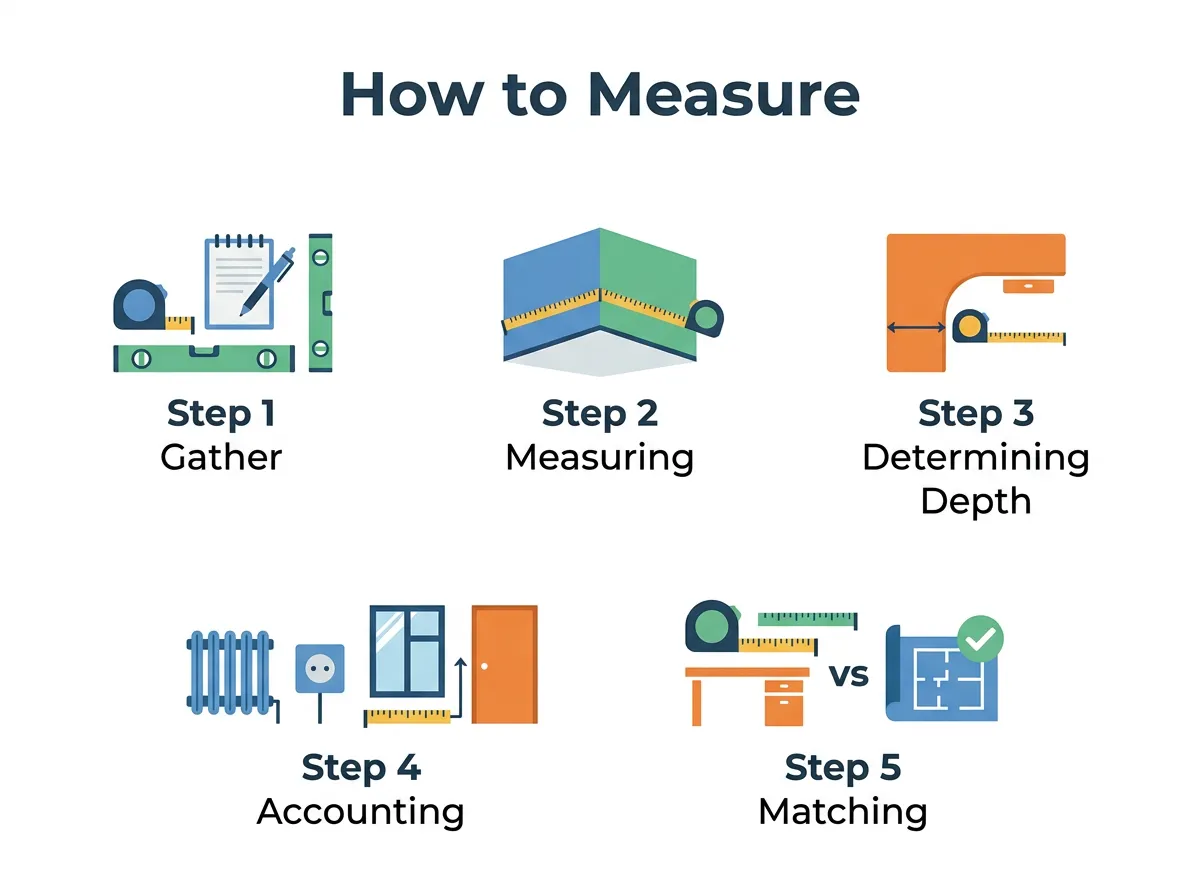
How to Measure for a Corner Desk — key points at a glance
Measuring the Left Wall
Start at the inner corner where the two walls meet. Place the end of your tape measure flat against the corner. Stretch the tape out along the left wall. Stop at the point where you want the desk to end. This is your maximum left-side length. Write this number down as “Left Wall Length.”
Measuring the Right Wall
Now, go back to the inner corner. Place your tape measure in the corner again. This time, stretch it along the right wall. Stop where you want the desk to end on this side. Write this number down as “Right Wall Length.” Remember, these two sides do not have to be equal. Many corner desks have one side longer than the other.
Understanding these two dimensions is key when learning how to measure for a corner desk. It gives you the basic shape of your workspace.
Step 3: Determining Depth and Chair Clearance
Wall length is only half the battle. You also need to think about depth. The depth of a desk is how far it sticks out from the wall. If a desk is too deep, it will block your room. If it is too shallow, your computer monitor will be too close to your eyes.
Desktop Depth
Most standard desks have a depth of 24 to 30 inches. If you use a small laptop, a shallower depth of 20 to 24 inches might work. However, if you have a large monitor, you will need more depth. Measure from the wall outward into the room to see how far the desk will reach. Make sure you still have plenty of room to walk past the desk.
Diagonal Clearance and the Seating Area
When studying how to measure for a corner desk, many people forget about diagonal clearance. This is the distance from the inner corner to the outer edge of the desk. You will sit in this diagonal space. You need to make sure there is enough room for your office chair.
Measure the space behind where you will sit. Pull your chair out. How much room does it take? You should leave at least 30 inches of open space behind the desk. This allows you to push your chair back and stand up easily. Check out this guide on L-shaped desk sizes to see how different depths fit into small spaces.
Step 4: Accounting for Room Obstacles
Rooms are rarely perfect. They have outlets, baseboards, vents, and doors. These obstacles can ruin your plans if you do not measure them. An important part of how to measure for a corner desk involves spotting room obstacles early.
Baseboards and Wall Trim
Baseboards run along the bottom of your walls. They stick out about half an inch or more. If you measure from the wall but your desk hits the baseboard, your desk will not sit flush. Always measure from the baseboard rather than the bare wall. This prevents unexpected gaps.
Power Outlets and Cord Space
Your computer, monitor, and lamp need power. Locate all the outlets near your corner. Will the desk block them? If the desk blocks an outlet, can you still plug things in? Sometimes, you might need to leave a one-inch gap behind the desk for plugs. Keep this in mind when writing down your final measurements.
Doors and Windows
Open every door near the corner. Does the door swing into the desk area? If it does, you will constantly hit your desk with the door. Measure the swing path of your doors. Also, look at the windows. Make sure the desk does not block nice natural light or make it hard to open the window.
Step 5: Matching Your Desk to Your Layout
Now you have your measurements. It is time to think about the layout. Not all corner desks are shaped the same way. Knowing how to measure for a corner desk helps you choose between different styles.
Symmetrical vs. Asymmetrical Desks
A symmetrical desk has legs of equal length. An asymmetrical desk has one side that is longer than the other. If you have more space on your right wall, you should look for a right-hand return desk. If you have more space on the left, get a left-hand return. Choosing the right layout can make a huge difference. You can learn more about finding a corner desk layout that matches your specific room shape to maximize your workflow.
Using Painter’s Tape to Test Your Plan
This is where your painter’s tape comes in handy. Take your measurements and tape them out on the floor. Draw the exact outline of the desk on your carpet or wood floor. Now, place your office chair inside the tape outline. Sit down and move around. This simple trick lets you experience the desk before you spend a single cent. It is the absolute best way to catch any layout mistakes early.
Step 6: Double-Check Your Paths and Delivery
When you learn how to measure for a corner desk, you also need to think about delivery day. You might find the perfect desk that fits your room. But will it fit through your front door? Many people forget to measure their hallways, staircases, and doorways.
If the desk comes in a large box, you need to make sure you can carry it into the room. Measure the width of your doorways before you order. This prevents the heartbreak of a desk that fits your office but cannot get past the front door.
Conclusion
Measuring for a corner desk does not have to be stressful. By taking your time and following these steps, you can find a desk that fits your room perfectly. Remember to measure both walls, check your depth, and account for obstacles like baseboards and outlets. Using painter’s tape to mock up the desk on your floor is a great way to ensure success. Once you know how to measure for a corner desk, you can buy your new furniture with total peace of mind. Your dream home office is just a few measurements away!
Frequently Asked Questions
How much space do you need for a corner desk?
Most corner desks require at least 50 to 70 inches of wall space on each side. You also need about 30 inches of depth for your chair and legs. Always measure your specific room to find the best fit.
Do corner desks save space?
Yes, corner desks are excellent space savers because they use empty corners that often go wasted. They provide a large work surface without taking up the center of the room. This makes them perfect for small bedrooms and home offices.
How do you measure the depth of an L-shaped desk?
To measure the depth, measure from the back wall to the front edge of the desk surface. Most desks have a depth between 20 and 30 inches. Make sure this depth allows your chair to move easily.
Should a corner desk face the window?
Facing the window can provide great natural light, but it might cause glare on your screen. Placing the desk next to a window is often the best compromise. This setup keeps your workspace bright without hurting your eyes.
How do you measure the diagonal width of a corner desk?
Place your tape measure in the very corner of the walls and stretch it diagonally to the outer corner of the desk. This measurement shows you how deep your seating area will be. It is crucial for ensuring your chair fits comfortably.
Can you put a corner desk on carpet?
Yes, you can place a corner desk on carpet, but a heavy desk might leave temporary dents. If your office chair has wheels, you should use a plastic chair mat. This mat protects your carpet and helps your chair roll smoothly.
